
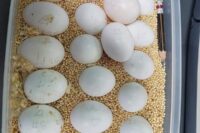
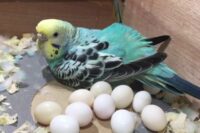
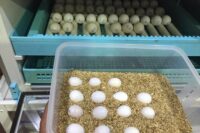
Fertile Conure Eggs
Price range: $50.00 through $249.98
| Parameter | Optimal Range |
| Incubation Period | 23 to 27 Days (varies by species) |
| Temperature | 99.5°F (37.5\°C) |
| Humidity | 40-50% (Days 1-20) / 65-70% (Lockdown/Hatch) |
| Turning | 3 to 5 times daily (minimum) |
Fertile Conure Eggs
The Beginning of the Journey
Purchasing or managing fertile conure eggs is a high-stakes endeavor that requires specialized equipment and a deep understanding of avian embryology. Whether you are dealing with Green-cheeks, Sun Conures, or Blue-crowns, the incubation process is delicate and leaves very little room for error.
Incubation Requirements
| Parameter | Optimal Range |
| Incubation Period | 23 to 27 Days (varies by species) |
| Temperature | 99.5°F (37.5°C) |
| Humidity | 40-50% (Days 1-20) / 65-70% (Lockdown/Hatch) |
| Turning | 3 to 5 times daily (minimum) |
Key Stages of Development
1. Candling (Day 5–7)
By shining a high-intensity LED light through the shell, you can check for fertility.
-
Fertile: You will see a small red “spider” (the embryo) with tiny veins spreading out.
-
Infertile: The egg remains “clear” or yellow inside.
2. The Drawdown (Weight Loss)
For a healthy hatch, a conure egg must lose approximately 15% of its initial weight through moisture evaporation. If humidity is too high, the chick may grow too large and drown in the air cell; if too low, the chick may become “shrink-wrapped” in the membrane.
3. Internal & External Pipping
-
Internal Pip: The chick pierces the internal membrane into the air cell. You may hear faint “peeps” from inside the egg.
-
External Pip: The chick makes its first small hole in the outer shell. Do not interfere at this stage unless 24 hours pass without progress, as the chick is still absorbing its yolk sac.
Critical Equipment for Success
If you are planning to hatch conure eggs, you must have your “nursery” set up before the eggs arrive:
-
High-Precision Incubator: Must have automatic turning and digital humidity/temp sensors (like the 120-Egg Elite or a dedicated Brinsea/Rila unit).
-
Brooder: Once hatched, the “pinkie” (hatchling) cannot regulate its own body temperature. It must go immediately into a $95\text{°F}$ ($35\text{°C}$) environment.
-
Hand-Feeding Kit: Includes specialized parrot formula (like Kaytee or Higgins), high-precision scales, and feeding syringes.
| Quantity |
1 Egg ,2 Eggs ,5 Eggs ,10 Eggs |
|---|

Reviews
There are no reviews yet.