
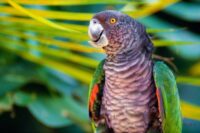
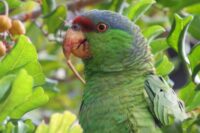
Kawalls Amazon
$649.98
| Feature | Details |
| Common Name | Kawall’s Amazon / White-cheeked Amazon |
| Scientific Name | Amazona kawalli |
| Average Size | 14 to 15 inches (1.16 to 1.25 feet) |
| Lifespan | 40 to 60+ years (typical for large Amazons) |
| Status | Least Concern (but declining due to habitat loss) |
| Native Range | Central Amazon Basin, Brazil (Amazonas & Pará) |
The Kawall’s Amazon (Amazona kawalli)
The Re-discovered Ghost of the Riverbank
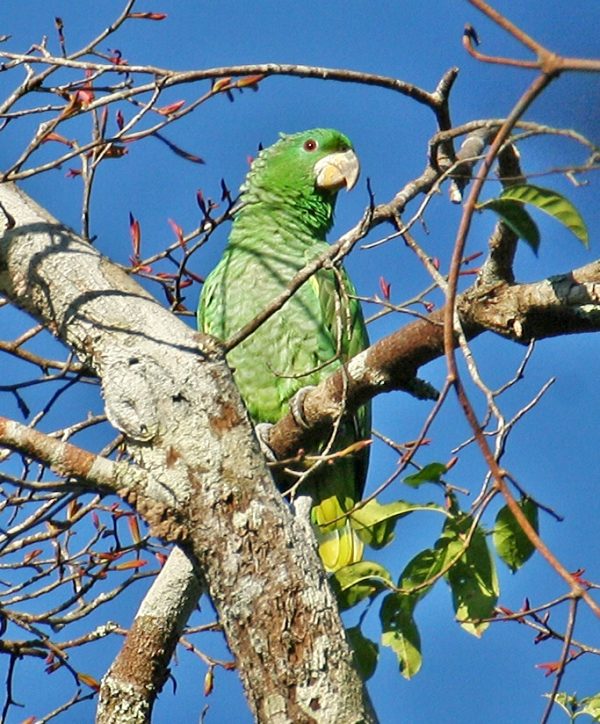
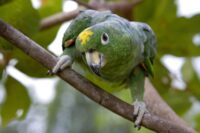
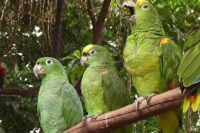
The Kawall’s Amazon, also known as the White-cheeked Amazon, is a fascinating “miracle” bird in the ornithological world. For over 70 years, it was thought to be extinct or simply an “aberrant” version of the Mealy Amazon. It was only officially re-described as a unique species in 1989 after being re-discovered in the wild in the mid-1980s.
Named after the Brazilian bird enthusiast Nelson Kawall, who first noticed the bird’s distinct features in his own collection, this parrot is a specialist of the flooded forests and riverine edges of the central Amazon basin in Brazil.
Key Characteristics
-
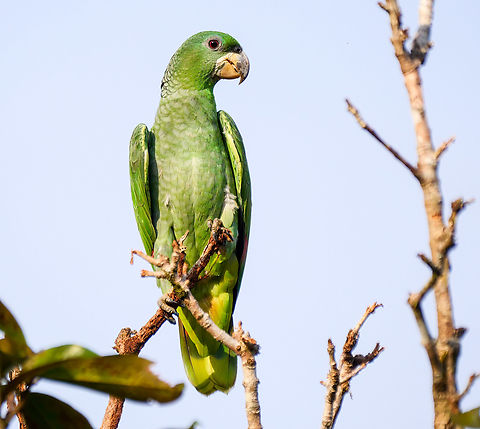
The “White Face” Patch: Its most defining feature is a distinct patch of bare, white-to-buff skin at the base of its bill (the rictus), which acts like a “saddle” that other Amazons lack.
-
Brighter Green Hue: While it resembles the Mealy Amazon in size, its green plumage is noticeably more vibrant and yellowish-green, lacking the heavy “mealy” or frosted gray appearance of its cousin.
-
Red Tail Base: It features brilliant red panels at the base of its side tail feathers, which are bordered by purple-blue—a flash of color most visible when the bird is preening or in flight.
-
River Specialist: They are highly forest-dependent and show a strong preference for Várzea (permanently flooded) woodlands and the edges of major rivers.
Quick Facts
| Feature | Details |
| Common Name | Kawall’s Amazon / White-cheeked Amazon |
| Scientific Name | Amazona kawalli |
| Average Size | 14 to 15 inches (1.16 to 1.25 feet) |
| Lifespan | 40 to 60+ years (typical for large Amazons) |
| Status | Least Concern (but declining due to habitat loss) |
| Native Range | Central Amazon Basin, Brazil (Amazonas & Pará) |
Distinct Differences: Kawall’s vs. Mealy
Because they were confused for so long, here is how to tell them apart:
-
The Beak Base: Kawall’s has a white patch of skin at the base; the Mealy does not.
-
The Eye Ring: Kawall’s has a relatively small, greyish ocular ring; the Mealy’s is typically larger and whiter.
-
Voice: Kawall’s has a unique vocalization, often described as a rhythmic “wheeou, wheeou” during flight.
-
Overall Color: Kawall’s is a “brighter” green bird compared to the “dusty” green of the Mealy.
Care & Conservation
Kawall’s Amazons are exceptionally rare in captivity and are primarily studied in their wild habitat:
-
Flooded Habitat Diet: In the wild, they have a unique diet that includes the bark of Macrolobium trees, palm fruits, and seeds from flooded forest species.
-
Breeding Cycle: Their nesting habits are tied to the seasons; they often find nesting cavities in the dry season but wait until the forest is flooded to raise their young.
-
Threats: While currently listed as Least Concern, their population is declining. They are highly susceptible to the loss of riverine forests due to cattle ranching and hydroelectric projects.
Is a Kawall’s Amazon Right for You?
Due to their rarity and specialized needs, Kawall’s Amazons are almost never found in the pet trade. They are a “holy grail” for conservationists and bird watchers. If you are a dedicated enthusiast, supporting habitat preservation in the Amazon basin is the best way to interact with this species.
Related products
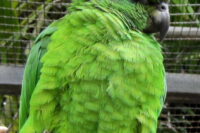


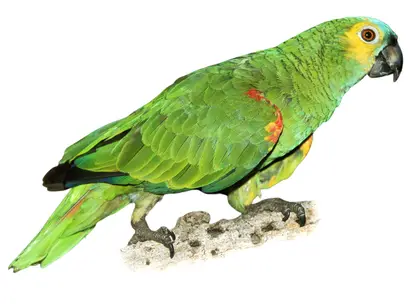
Blue Front Amazon
| Feature | Details |
| Common Name | Blue-fronted Amazon / Turquoise-fronted |
| Scientific Name | Amazona aestiva |
| Average Size | 14 to 15 inches (1.16 to 1.25 feet) |
| Lifespan | 50 to 70+ years with proper care |
| Temperament | Social, outgoing, and highly intelligent |
| Speech Ability | Excellent; one of the best in the parrot world |
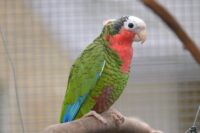
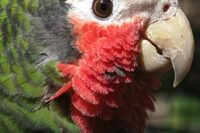
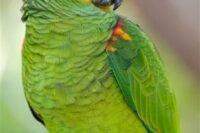
Cuban Amazon
| Feature | Details |
| Common Name | Cuban Amazon / Rose-throated Parrot |
| Scientific Name | Amazona leucocephala |
| Average Size | 11 to 13 inches (0.92 to 1.08 feet) |
| Lifespan | 50 to 60+ years with proper care |
| Temperament | Intelligent, social, and bold (can be aggressive) |
| Speech Ability | Excellent; high-clarity mimics of speech and song |


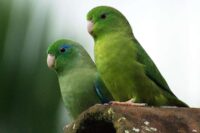
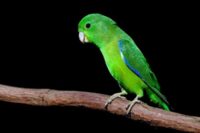
Manu Parrotlet
| Feature | Details |
| Common Name | Manu Parrotlet / Amazonian Parrotlet |
| Scientific Name | Nannopsittaca dachilleae |
| Average Size | 4.7 to 5 inches (12 cm) |
| Weight | 38 to 46 grams (about the weight of a few coins) |
| Lifespan | 10 to 15 years (estimated in the wild) |
| Status | Least Concern / Near Threatened (Range-restricted) |
Reviews
There are no reviews yet.